How Much Water Is Polluted

You wake up, brush your teeth, and pour a glass of water without a second thought. But that glass? It’s part of a global story that’s way more tangled than your morning routin...

You wake up, brush your teeth, and pour a glass of water without a second thought. But that glass? It’s part of a global story that’s way more tangled than your morning routine. We’re talking about pollution—and not the kind you can see floating in a river.
The stats hit like a cold splash. According to the United Nations, over 80% of the world’s wastewater flows back into the environment without being treated or reused. That’s not just a number; it’s eight out of every ten buckets of water you use, washing straight into lakes, rivers, and oceans.
Think of it as the planet’s worst laundry cycle—filthy water going out, dirty water coming back in. And it’s not just developing nations; industrial runoff and agricultural chemicals taint water sources from the Mississippi to the Mekong.
Must Read
The Numbers Game (It’s Not Fun)
Here’s where it gets real: about 2 billion people drink water contaminated with feces, per the World Health Organization. That’s more than the entire population of the Americas—drinking a cocktail of bacteria and viruses daily.
Plastic pollution adds another layer of grim. Every minute, a garbage truck’s worth of plastic dumps into the ocean. By 2050, there could be more plastic in the sea than fish by weight. Imagine swimming through a watery Tupperware drawer.
Even freshwater isn’t safe. A 2022 study found PFAS—those “forever chemicals” in non-stick pans and raincoats—in rainwater everywhere, from the Himalayas to Antarctica. Nothing is untouched.
Where Does All This Dirty Water Come From?
Agriculture is the heavyweight champion of water pollution. Fertilizers and pesticides run off fields, creating dead zones in oceans—like the one in the Gulf of Mexico, which can be as big as New Jersey. Your salad has a carbon footprint, but it also leaves a watery trail.
Industry dumps heavy metals and toxins straight into waterways. Think of the Cuyahoga River in Ohio, which caught fire in 1969. It’s cleaner now, but many rivers in Asia and Africa still carry a chemical burden that would make a science lab wince.
Then there’s us—our homes. Every flush, every drain from a washing machine, sends microplastics and pharmaceuticals downstream. That aspirin you took? It might end up in a fish’s bloodstream.
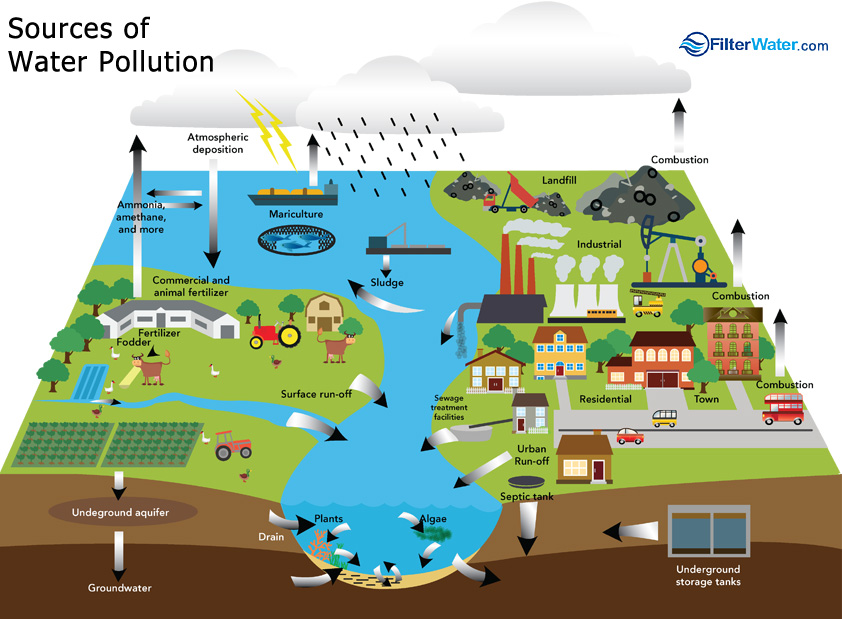 Water Pollution: Effects on health and sustainability | THRIVE Project
The Cultural Shock of Dirty Water
Remember the scene in Erin Brockovich where the water glows? That’s Hollywood, but real life has its own drama. In Flint, Michigan, the crisis made lead poisoning a dinner-table topic. Meanwhile, in India, the Ganges River is both sacred and severely polluted—a spiritual paradox that millions live with daily.
Pop culture has noticed. Billie Eilish’s music video for “All the Good Girls Go to Hell” shows an oil-soaked angel. It’s a metaphor, but the visual of black, sticky water is closer to reality than fantasy. Even your favorite influencer’s plastic water bottle has a life after the sip.
Fun fact: the plastic bottle you recycle today could become a park bench—or float in the Great Pacific Garbage Patch, which is twice the size of Texas. That patch isn’t a solid island; it’s a soupy mess of particles, like glitter made of trash.
Practical Tips to Turn the Tide
You don’t need to move to a cabin in the woods. Start with one swap: replace your bottled water habit with a reusable metal bottle. If you buy one a week, that’s 52 less bottles in the cycle—easy math, big impact.
Check your cleaning products. Many contain phosphates and microbeads that wash right into waterways. Look for “biodegradable” or “phosphate-free” labels. It’s like choosing a salad over a cheeseburger for the planet.
Garden smarter. If you use fertilizers, stick to organic ones and keep them away from storm drains. A little mulch goes a long way in preventing runoff—and your tomatoes will thank you.
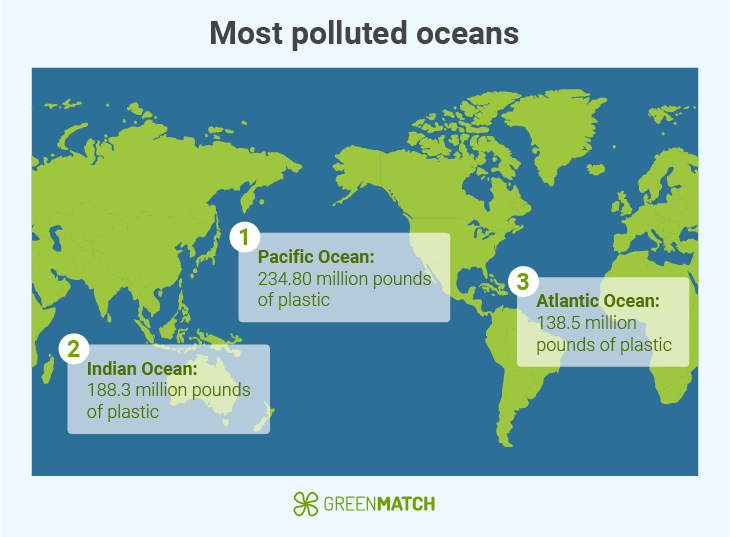 Littering Statistics 2025
Here’s a wild one: flush less. Not the toilet (please flush), but skip the “flushable” wipes. They’re not actually flushable—they clog pipes and end up in rivers. Your plumbing and the ocean will both breathe easier.
The Fun Facts That Stick
Did you know that a single gallon of motor oil can contaminate a million gallons of fresh water? That’s enough for 50,000 people’s daily drinking supply. Leaky cars are silent polluters.
Or that a beaver’s dam actually cleans water? Their ponds trap sediment and pollutants. Beavers are nature’s unpaid water treatment plants—proof that ecosystems know best.
And here’s a hopeful one: in 2022, the Ocean Cleanup Project removed over 100,000 kilograms of plastic from the Great Pacific Garbage Patch. Technology is catching up to our mess—just slowly.
A Short Reflection for Your Day
Every drop you touch has a journey. The water in your coffee might have passed through a dinosaur, a factory, and a fish before reaching your cup. That’s not scary—it’s a reminder that we’re all connected by the same blue thread.
Tonight, when you turn on the tap, pause for a second. The water is clean because someone, somewhere, made a choice—maybe a scientist, a policy maker, or a neighbor who didn’t litter. You get to make that choice too.
So take a sip. Let it be a toast to the clean stuff, and a quiet nod to the messy truth. The next glass of water you drink? It’s a vote for the world you want to live in—one drop at a time.
